
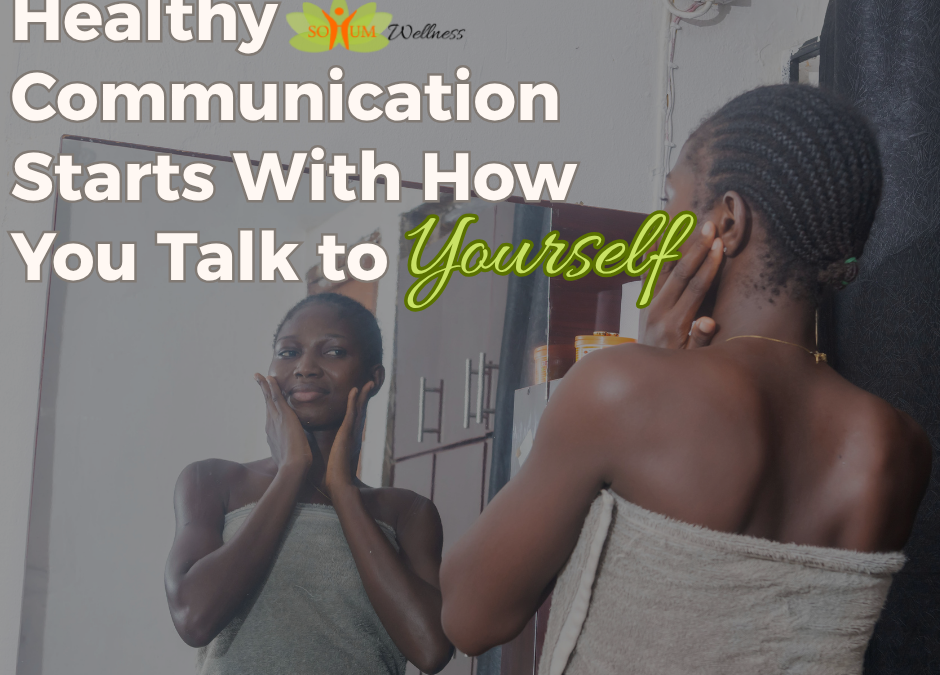
When we think about healthy communication, we usually think about how we communicate with other people. Are we listening? Are we expressing what we need? Are we being clear, respectful, and honest?
But there is another conversation happening throughout the day that can have just as much impact on our wellbeing: the conversation we have with ourselves.
Our internal dialogue is often so automatic that we barely notice it. We make a mistake and think, “I should have known better.” We have a difficult day and tell ourselves, “I need to get it together.” We look at everything we have not accomplished and wonder why we cannot seem to keep up.
We may never speak to someone we care about this way, yet we can be remarkably comfortable speaking to ourselves this way. And when that inner conversation happens over and over again, it matters.
Your Inner Voice Matters
The way we talk to ourselves affects more than our mood. It can influence how we respond to stress, how confident we feel, the choices we make, and even how we communicate with the people around us.
Think about what happens when you are already overwhelmed and then add an internal voice telling you that you should not be overwhelmed. Now you are dealing with two things: the situation itself and your judgment about how you are handling it.
The same thing can happen when we are worried, disappointed, embarrassed, or simply tired. Instead of acknowledging what we are experiencing, we sometimes criticize ourselves for experiencing it at all. Over time, that can make difficult moments feel even heavier.
Healthy communication with yourself does not mean pretending everything is wonderful. It is not about replacing every uncomfortable thought with a positive affirmation or convincing yourself that something does not bother you when it clearly does.
It means learning to speak to yourself with the same combination of honesty, patience, and compassion that you would hopefully bring to someone else.
What Does Unhealthy Self-Talk Sound Like?
Because our internal dialogue happens so quickly, we may not recognize how often we are criticizing ourselves. Sometimes it is obvious: “I am terrible at this.” But sometimes it is much more subtle.
“I should be doing more.” “Everyone else seems to have this figured out.” “I should not feel this way.” “I cannot believe I did that.” “I will never get caught up.” “Why can’t I just handle this?”
None of these thoughts may seem particularly significant on their own. But when they become the soundtrack running quietly in the background of our days, they can influence how we see ourselves and our circumstances.
One word worth paying particular attention to is should. Should can be useful when it reflects something genuinely important. But often our shoulds come from expectations we have placed on ourselves without ever stopping to question them.
I should be more productive. I should be able to manage this myself. I should have accomplished more by now. I should be happier.
When you notice a should, it can be helpful to pause and ask: According to whom? Sometimes the expectation is reasonable. Sometimes it is not.

Accountability Does Not Require Criticism
One reason people resist changing negative self-talk is the belief that being hard on themselves keeps them motivated. If we stop criticizing ourselves, will we become complacent? Not necessarily.
There is an important difference between taking responsibility and attacking yourself.
“I did not handle that conversation the way I wanted to. What could I do differently next time?” creates an opportunity to learn. “I always mess things up. Why can’t I get this right?” usually does not.
Both acknowledge that something did not go well. Only one gives you somewhere productive to go next.
Healthy self-communication is not about giving yourself a free pass. You can acknowledge a mistake, apologize, make a change, set a boundary, or decide that you need to do something differently without making yourself the enemy in the process.
In fact, curiosity is often far more useful than criticism. Instead of asking, “What is wrong with me?” try asking, “What is happening here?” That small change can open the door to understanding rather than judgment.
Notice the Conversation Before You Try to Change It
You do not have to monitor every thought you have. That would probably become another exhausting task on your to-do list. Instead, start by paying attention during moments when your emotions are stronger.
What do you say to yourself when you are stressed? What happens internally when you make a mistake? How do you speak to yourself when you look in the mirror, forget something, lose your patience, need help, or do not accomplish everything you planned?
You may begin to notice patterns. Maybe you expect yourself to do more than you would reasonably expect from someone else. Maybe you minimize your accomplishments but magnify your mistakes. Maybe you offer everyone around you grace while giving yourself very little.
The goal is not to judge those patterns either. It is simply to notice them. Awareness gives us choices.
Try Changing the Conversation
Once you notice a thought, you can decide whether it is actually helpful. A simple question can be powerful: Would I say this to someone I care about?
If the answer is no, you do not have to swing to the opposite extreme and tell yourself something you do not believe. Just make the thought more accurate, useful, and compassionate.
Instead of, “I am terrible at this,” try, “I am still learning how to do this.”
Instead of, “I should be able to handle all of this,” try, “There is a lot happening right now. What actually needs my attention first?”
Instead of, “I cannot believe I did that,” try, “That did not go the way I wanted. What can I learn from it?”
Instead of, “I am so behind,” try, “I cannot do everything at once. What is one thing I can do next?”
This is not about finding perfect words. It is about changing the tone of the conversation.
Give Yourself the Same Opportunity to Be Human
We tend to understand that other people have difficult days. They get tired. They make mistakes. They become overwhelmed. They sometimes need help, rest, reassurance, or another chance. We do not always extend ourselves the same understanding.
Healthy communication with yourself includes making room for your own humanity.
Some days you will be productive. Some days you will not. Sometimes you will respond exactly the way you hoped you would. Sometimes you will wish you had handled something differently.
You can learn, adjust, and grow without requiring perfection from yourself along the way.
Healthy Communication Begins Within
We spend a great deal of time learning how to communicate more effectively with others, and those skills matter.
But healthy communication also includes how we listen to ourselves, respond to our own needs, navigate mistakes, and make sense of difficult moments.
Over the next few days, simply notice your inner conversation. You do not need to fix every thought. Just become curious about what you are saying and whether those words are helping you.
You are part of every conversation you have. And sometimes improving the way you communicate with everyone else begins by paying closer attention to the conversation happening inside your own head.
Continue the Conversation in the Fall Wellness Circle
Healthy communication takes practice, and sometimes having the space to explore these ideas with others can help us see our own patterns a little more clearly.
This September, the Sohum Wellness Fall Wellness Circle begins with Healthy Communication, where we will explore how we communicate with ourselves and others and how greater awareness can support healthier relationships and overall wellbeing.
The Fall Wellness Circle meets monthly from September through December, with both Thursday evening and Saturday morning options.
September: Healthy Communication
Thursday, September 17 at 6:00 PM
Saturday, September 19 at 10:00 AM
We would love to have you join us for September and continue with us throughout the fall.
Proudly powered by WordPress
Recent Comments