
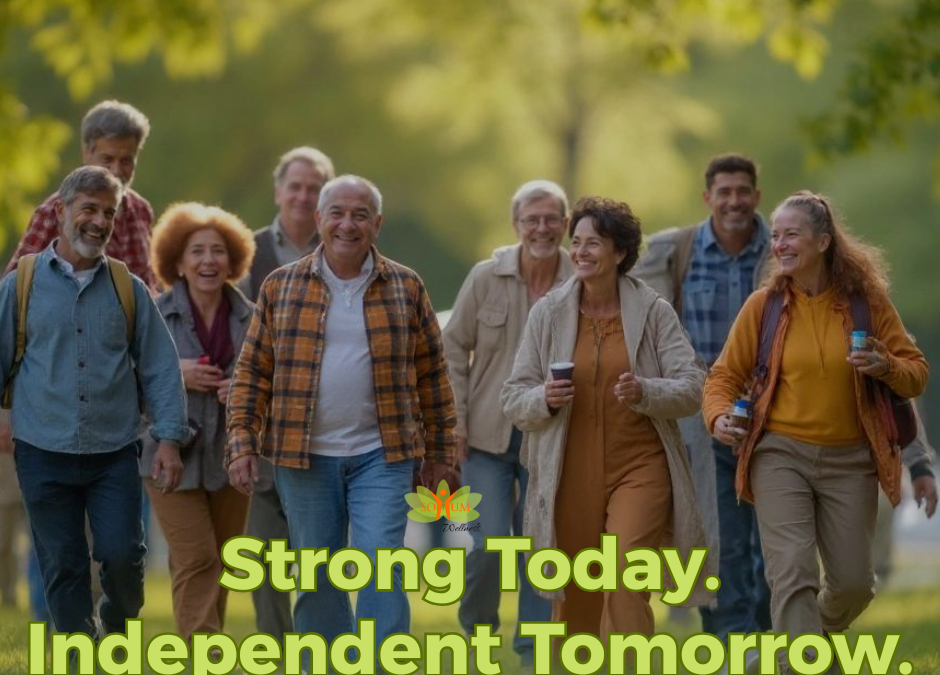
When we think about staying healthy as we get older, we often think about things like eating well, getting enough sleep, keeping up with doctor appointments, and staying active. But there’s another question worth asking: Will your body continue to let you do the things you want to do?
Can you get up from a chair easily, carry groceries into the house, climb a flight of stairs, get down on the floor and back up again, or walk comfortably through an airport, a park, or your neighborhood? These everyday activities may not feel like “fitness,” but they have a lot to do with strength, balance, mobility, and posture.
Maintaining those abilities can play an important role in staying active and independent as we age.
Strength Is About More Than Muscle
When people hear “strength training,” they sometimes picture heavy weights and complicated gym equipment. It doesn’t have to look like that.
Functional strength is the strength we use in everyday life. It helps us stand up from a chair, lift a laundry basket, carry groceries, open a heavy door, climb stairs, garden, play with grandchildren, and continue doing many of the activities we enjoy.
We naturally lose some muscle mass and strength as we get older. That makes being intentional about maintaining strength increasingly important. The goal isn’t necessarily to become stronger than everyone else. It’s to remain strong enough for your life.
Balance Deserves More Attention
Balance is something most of us barely think about until it becomes difficult. Yet we use it constantly when stepping off a curb, walking across uneven ground, getting in and out of the shower, reaching into a cabinet, or putting on a pair of pants while standing.
Good balance involves coordination between several systems in the body, and like strength, it can change as we age. That doesn’t mean we simply have to accept worsening balance.
Practicing balance and maintaining lower-body strength can help us feel more stable and confident during everyday activities. Even simple activities, such as practicing standing on one foot near a sturdy support or regularly walking on different safe surfaces, can challenge the systems involved in balance.
If you have significant balance problems, dizziness, a history of falls, or a medical condition that affects movement, talk with your healthcare provider before beginning new exercises.
Keep Moving So You Can Keep Moving
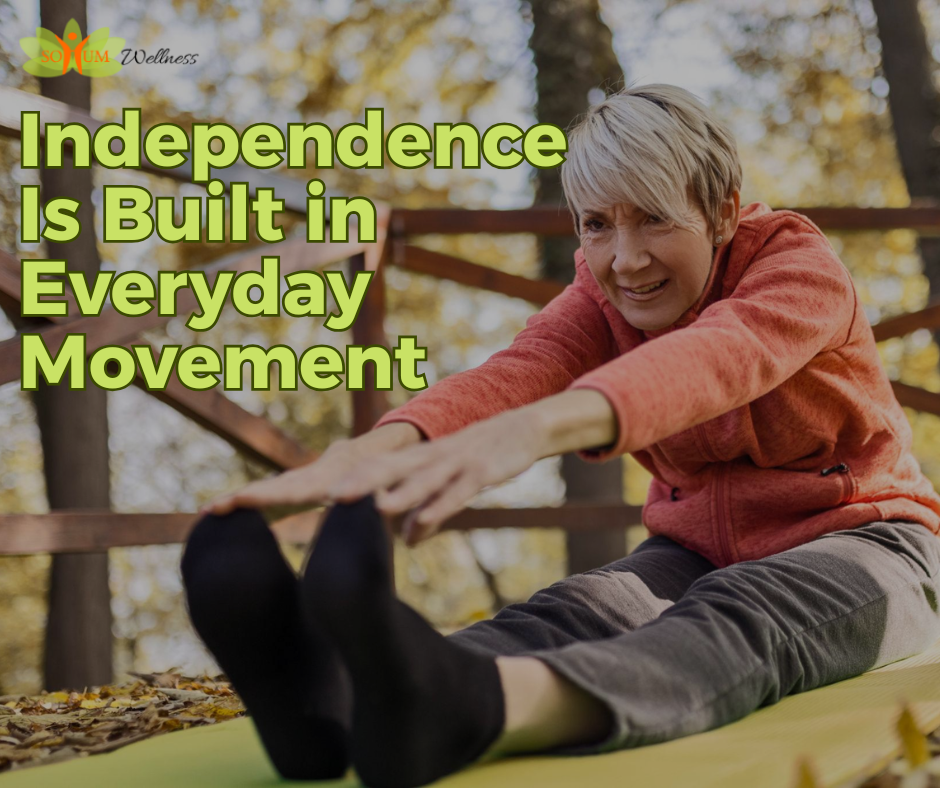
Mobility is our ability to move freely and comfortably, and changes can happen gradually. Perhaps reaching overhead isn’t as easy as it used to be. Turning to look behind you feels tighter. Getting down onto the floor requires a little more planning. Your hips or shoulders don’t move quite as freely.
It can be tempting to avoid movements that feel difficult. Unfortunately, moving less can sometimes make movement even harder.
Regular activity, stretching, and moving our joints through a comfortable range of motion can help us maintain the ability to do the things everyday life requires. You don’t have to become extremely flexible. The goal is simply to keep your body moving.
Don’t Forget About Posture
Our daily habits have changed dramatically. We spend hours looking at computers, phones, tablets, and televisions, and many of us sit for long stretches without realizing how much time has passed. Over time, those habits can affect how we hold and move our bodies.
Try checking in with yourself throughout the day. Are your shoulders creeping toward your ears? Are you leaning forward toward your screen? Have you been sitting in the same position for two hours?
Sometimes the simplest wellness habit is getting up, stretching, changing position, and moving for a few minutes.
Independence Is Built in Ordinary Moments
We often think about independence as something we either have or lose much later in life. But many of the abilities that support independence are things we can work on today.
Think about the movements you use during an average day: standing, walking, reaching, bending, lifting, carrying, turning, and climbing. Maintaining these abilities helps us continue participating in our own lives.
And that’s really the bigger goal. It’s not about exercising because someone tells us we should. It’s about being able to travel, work in the garden, play with the kids or grandkids, meet friends for an afternoon out, take care of our homes, enjoy our hobbies, and continue saying yes to the things we want to do.
Start Where You Are
You don’t need to overhaul your life this week. Choose one place to begin. Take a walk. Practice getting up from a chair several times. Add simple resistance exercises to your routine. Stretch after sitting for a long period. Practice your balance safely. Pay attention to your posture while working.
Most importantly, choose activities you can realistically continue doing. Consistency is much more useful than an ambitious routine you abandon after two weeks.
Your body carries you through your entire life. Taking care of your strength, balance, mobility, and movement today can help you keep doing more of what you love tomorrow.
Join Us: Strong Body, Steady Life
Our first Fall Wellness Circle session is Strong Body, Steady Life on Saturday, October 10. We’ll explore strength, balance, mobility, posture, and practical ways to support continued independence as we age.
This is the first session in our four-part Fall Wellness Circle, which continues through December with topics focused on brain health, mindset and resilience, and creating a meaningful next chapter.
Recent Comments